What actually happens before the paint goes on
The finish you see on day five depends on a lot of quiet work done on day one.
October 27, 2026 · 4 min read
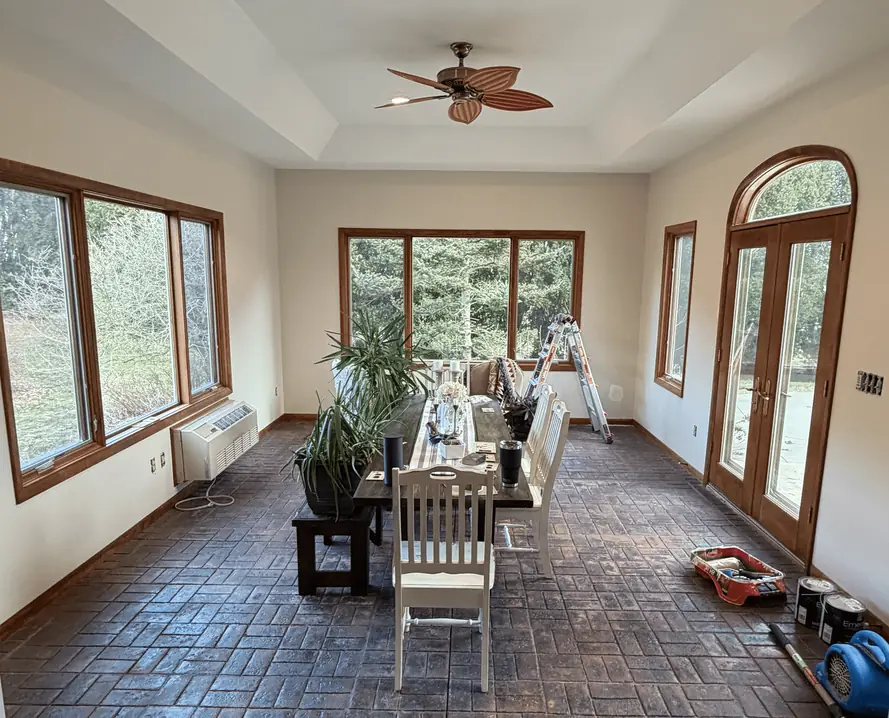
When people picture a painting job, they picture rollers and fresh colour. The part that decides whether the job looks good in a year is the part nobody films. It happens before the lid comes off the can, and on a well-run job it takes up more of the schedule than newcomers expect.
Olympus Painting puts it in a single line on their site: “Proper preparation, quality materials, and proven techniques. No shortcuts.” Here's what that looks like in practice, step by step, so you know what to expect in your own home.
Protecting your floors and furniture
Before anything else, the room gets covered. Floors go under drop cloths or protective sheeting. Furniture that can't leave the room is moved to the centre and wrapped. Light fixtures, outlets and anything else near the work get covered or masked. Olympus lists floor and furniture protection as part of its residential process, and it's a good sign when a painter mentions it without being asked.
This step sounds boring until you've seen what a splatter does to a hardwood floor or an upholstered chair. Careful protection is also a sign of how a crew treats your home generally.
- Floors covered wall to wall, with the edges taped where needed
- Furniture moved away from walls and wrapped
- Fixtures, switch plates and hardware removed or masked
- Doorways and adjoining rooms sealed off from dust where it makes sense
- Pets and small children kept out of the work area
Looking at the surface honestly
A walk-through with a painter shouldn't only be about colour. Good painters run a hand along the walls, look along them in raking light, and note what's wrong: nail pops, hairline cracks, dents from furniture, tape residue, water stains, old patches that were never sanded smooth. Every one of those will show through new paint, and darker or glossier paint shows them more.
This is also where honest estimates come from. Olympus talks about clear communication and honest estimates as one of its core values. If a ceiling has a stain that might come back, or a wall needs more than paint, you should hear about it before work starts.
Patching and repairing
Small holes and dents get filled. Cracks get opened slightly, filled and sanded. Bigger damage needs real drywall repair: cutting out the bad section, fitting new board, taping and coating the joints so the repair disappears. Olympus lists drywall repair and surface restoration as its own service for exactly this reason, because painting over a damaged wall just paints the damage.
Katie W. hired Nate for a bigger project that included removing wallpaper and fixing drywall before painting the ceiling, entertainment center and beams. That kind of sequence, remove, repair, then paint, is how a rough room turns into a clean one.
Sanding and cleaning
Patches are sanded flat and feathered into the wall until you can't feel the edge. Glossy trim gets scuffed so new paint can grip. Walls in kitchens and bathrooms get cleaned, because grease and soap film prevent adhesion just like they do on cabinets. Then the dust gets wiped or vacuumed away. Paint over dust and you get a gritty finish that never looks quite right.
Gaps between trim and wall get caulked. That small detail tidies the edges more than people expect, and it's the difference between a room that looks painted and a room that looks finished.
Priming the patches and the problem spots
Fresh filler soaks up paint differently from the wall around it. If you skip primer, the patched spots show up as dull patches under the finish, a flaw painters call flashing. Spot priming the repairs, or priming the whole surface where it's needed, evens out how the topcoat looks. Stains from water, smoke or marker need a stain-blocking primer or they bleed through.
Primer also matters when you go from a dark colour to a light one, or the reverse. It helps the new colour cover in fewer coats and look true to the sample you chose.
The order of work matters
Painters generally work from the top down. Ceilings first, then walls, then trim and doors, so drips and splashes land on surfaces that haven't been finished yet. Ashley L. had Nate paint her ceiling, trim and walls, and said: “Nate was great to work with for painting our ceiling, trim, and walls! He has great attention to detail.” Attention to detail is mostly this kind of order and care, repeated room after room.
Most of the time you can stay in your home during a residential job. Olympus says as much on its site. What you'll want is a clear plan for which rooms are off limits on which days, and that's a fair thing to ask for before you sign.
If you're weighing it up, call Nate at (419) 283-1282 or ask for a free estimate. He'll look at the actual space and tell you plainly what it needs.
Olympus Painting LLC, (419) 283-1282
Call (419) 283-1282More articles
Painting your kitchen cabinets instead of replacing them
When the boxes are sound and only the finish looks worn, refinishing can change the whole kitchen without a demolition.
When to paint your house exterior in Northwest Ohio
Exterior paint is only as good as the weather it dried in, and around here the weather doesn't always cooperate.