When to paint your house exterior in Northwest Ohio
Exterior paint is only as good as the weather it dried in, and around here the weather doesn't always cooperate.
October 27, 2026 · 4 min read
Exterior paint doesn't fail because the colour was wrong. It fails because it went on in bad conditions, or onto a surface that wasn't ready. In Northwest Ohio we get a wide range of weather, from humid summer days off the lake to hard freezes that arrive before you've put the ladders away. Timing the job well makes a visible difference to how long it lasts.
Why spring and fall do most of the work
Most exterior painting around Maumee, Perrysburg and Toledo happens in late spring, early summer and early fall. Those are the stretches when days are mild, nights aren't too cold and rain comes in predictable windows. Mid-summer can work too, but surfaces in direct sun can get hot enough that paint dries too fast on the wall, which can cause lap marks and poor adhesion.
Winter is mostly off the table for exterior work. Cold slows the way paint forms a film, and most exterior paints have a minimum temperature printed right on the can. A painter who respects that label will wait. One who doesn't will leave you with a finish that looks fine for a season and then cracks.
Temperature is only half of it
A warm afternoon doesn't mean good conditions if the night drops cold. Fresh paint needs to stay above the minimum temperature on the can while it sets up, not just while it's being applied. If frost is forecast overnight, an afternoon job that looked perfect can fail by morning.
The other half is moisture. Dew point is the temperature at which water condenses out of the air. When the surface cools down to the dew point, a thin film of moisture forms on it, even when nothing looks wet. Paint put onto a damp surface, or paint that gets dew on it before it has set, can blister, run or lose its grip. That's why painters pay attention to the evening forecast and don't push a job late into the day.
- Check that the daytime and overnight temperatures stay within the range on the paint can
- Look for a gap between the air temperature and the dew point, not just a dry afternoon
- Allow siding to dry fully after rain or a heavy dew before starting the day
- Avoid painting a wall in full midday sun when you can follow the shade around the house
- Leave enough dry days in the forecast for each coat to set
Freeze-thaw is what finds the weak spots
Northwest Ohio winters swing back and forth across freezing again and again. Water gets into small cracks in wood, caulk and old paint, freezes, expands, and pries the surface apart. Then it thaws and does it again. Paint that has already started to peel gives that water an easy way in.
That's an argument for painting before the failure spreads. Fix a peeling area when it's small and you may only need to scrape, prime and repaint that section. Wait several winters and you could be replacing rotted trim. A good painter will look closely at the caulk, the end grain of the trim and the lower courses of siding where water sits.
Algae and mildew on the shady side
The north face of a house and any wall under trees stays damp longer, and that's where green or black growth starts. Painting over it is a mistake, because the growth is alive and it holds moisture against the surface. The wall needs to be cleaned and allowed to dry, and any stubborn growth treated, before any primer goes on.
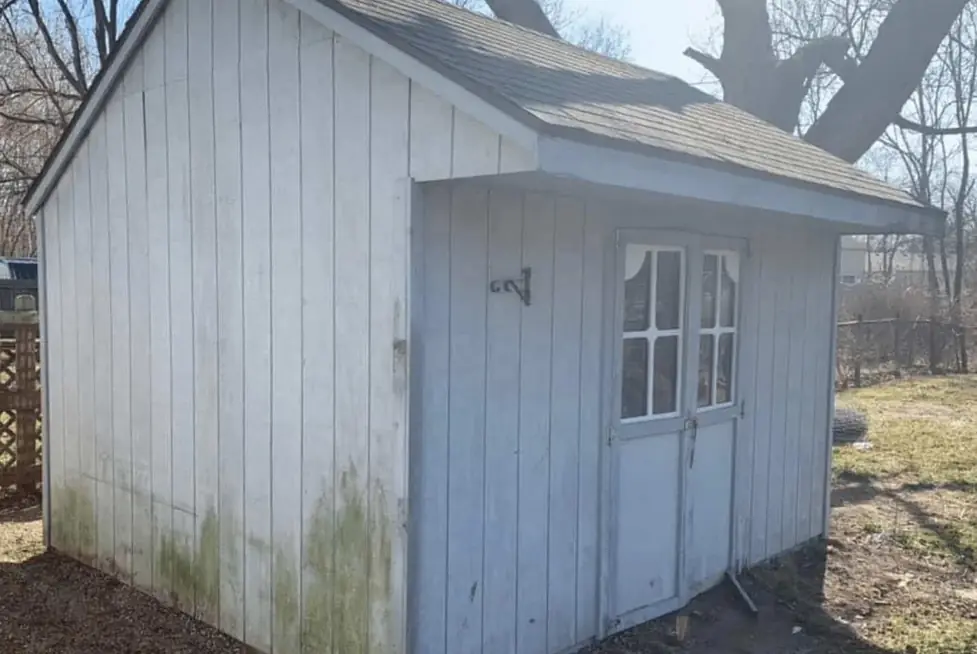
The before photo of a garden shed in the Olympus gallery shows this clearly. The white paint had peeled and there was algae at the base, right where moisture and shade collect. The after photo shows the same shed in a clean blue-grey finish. That result begins with cleaning and scraping, not with the first coat.
Prep takes the first days, not the last
People often assume exterior painting is mostly spraying or rolling. On a typical house, a lot of the time goes into washing, scraping, sanding, caulking, patching rot and priming bare spots. Olympus describes its exterior work as weather-resistant systems for siding, trim and other surfaces, and the word system is the right one. The paint is one layer in a series, and each layer depends on the one under it.
This matters for scheduling because prep needs dry weather too. If you book a painter for a certain week and it rains for three days, a good contractor will tell you the plan has changed instead of rushing coats onto damp siding.
Booking early makes the weather easier
The best conditions in Northwest Ohio don't last long, so good painters fill their calendars early. If you want a spring job, talk to someone in winter. If you want fall, start the conversation in late summer. Getting an estimate when you're not under pressure also lets you ask about prep, what areas have problems and how weather delays will be handled.
Olympus offers free estimates for homes in Maumee, Perrysburg, Toledo, Sylvania, Waterville and nearby communities, and it's worth having someone look at your siding and trim before you pick a season.
If you're weighing it up, call Nate at (419) 283-1282 or ask for a free estimate. He'll look at the actual space and tell you plainly what it needs.
Olympus Painting LLC, (419) 283-1282
Call (419) 283-1282More articles
Painting your kitchen cabinets instead of replacing them
When the boxes are sound and only the finish looks worn, refinishing can change the whole kitchen without a demolition.
What actually happens before the paint goes on
The finish you see on day five depends on a lot of quiet work done on day one.